Noise vs Signal
Why Clarity Doesn’t Come From Thinking Harder

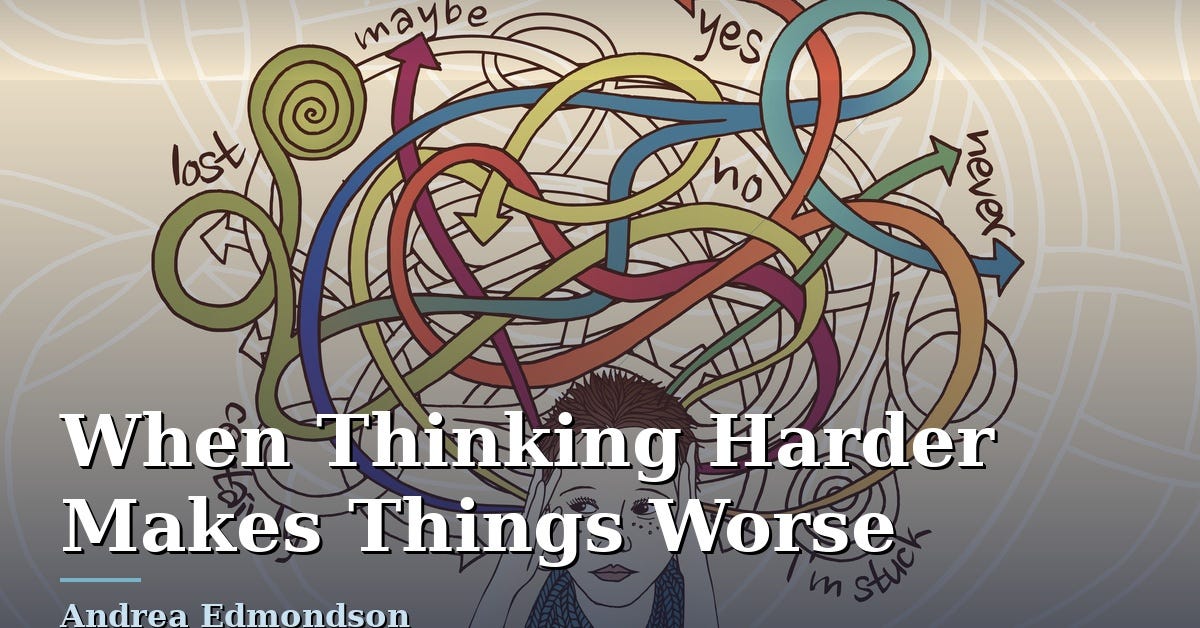
In earlier articles, I explored Capacity Before Strategy — the idea that the quality of your thinking, decisions, and performance depends on the state of the system behind them.
But there’s a layer beneath that.
Before strategy breaks down or execution falters, something more fundamental happens: we lose the ability to distinguish signal from noise.
I was recently working with a founder in the middle of scaling her business. From the outside, things looked strong. Funding conversations underway. Product progressing. Company moving forward.
Internally, it felt very different.
She described constant firefighting — a continuous stream of demands layering on top of each other. Not a single defining crisis, just an accumulation of competing priorities. What stood out wasn’t the volume of work. It was the way everything had started to feel equally urgent.
When everything is urgent, nothing is clear.
We tend to assume that noise is external — emails, meetings, the pace of modern work. But the more significant noise is internal.
It sounds like:
“I can’t switch off.” “I keep going round in circles.” “I know what I need to do, but I’m not doing it.”
Or it shows up more subtly in behaviour. You sit down to focus on what matters most — and somehow end up doing something else entirely, with a very convincing justification.
This isn’t a failure of discipline. It’s what happens when competing signals overwhelm the system and the nervous system shifts out of balance.
I saw the same pattern closer to home.
My daughter has just qualified as a doctor. Her current task: ranking hundreds of job options across locations and specialties. A structured process — except for one complication. She didn’t know how she would be ranked, which meant she couldn’t predict which roles would realistically be available to her.
The outcome sat just outside her control.
What started as a practical exercise became something more consuming. Multiple spreadsheets open. The same options revisited. Scenarios looping:
What if I choose this and it limits me later? What if I get it wrong?
From the outside, it looked like diligence. From the inside, it felt like pressure — a search for certainty that simply wasn’t available.
Her mind did what high-performing minds often do. It tried to create control where there was none: more analysis, more comparisons, more refinement. But instead of clarity, this produced the opposite.
More loops. More second-guessing. More noise.
This is not a question of capability. It’s a question of capacity.
When the system is under pressure, attention fragments and thinking accelerates. The brain shifts into prediction mode — scanning for risk, anticipating threat. In that state, everything feels important because everything is being evaluated through the lens of potential danger.
This is where the principle becomes critical:
The body goes first. The story follows the state.
When the nervous system is activated, the brain doesn’t operate as a neutral decision-maker. It generates narratives that match the physiological state — amplifying urgency, risk, and uncertainty.
In other words: the system generates noise.
The natural response is to think harder. More analysis. More discussion. More time spent working through the problem.
But this tends to make things worse.
It’s like trying to hear a quiet signal in a crowded room by adding more voices. The problem isn’t a lack of thinking. It’s the inability to filter what matters.
The shift, when it comes, is usually simpler than expected.
The founder didn’t need a new framework. My daughter didn’t need more data. What both needed was enough stillness for the system to settle — not the removal of noise, but a change in their relationship to it.
This begins with something deceptively simple.
Noticing what’s happening internally. Naming it — pressure, urgency, looping thoughts. Then creating a small interruption to that pattern.
A slower breath. A moment of grounding. A pause before acting.
Not dramatic interventions. But often enough to shift the state.
When the state shifts, something important happens. The noise doesn’t disappear, but it loses its intensity. And in that quieter space, signal becomes detectable.
Signal is rarely loud. It doesn’t compete with urgency. It tends to be simpler, more direct — and easy to overlook when the system is overloaded. But when it’s accessible, decisions become clearer. Priorities become obvious. Action becomes straightforward.
For leaders, this raises a different question.
When you feel overwhelmed or stuck, the instinct is to ask: What should I do?
A more useful question is: What state am I in?
If everything feels urgent, it’s often a sign that the system is overactivated — not that everything genuinely requires immediate attention. Creating even a small amount of stillness can be enough to change that perception.
Most leadership development focuses on improving thinking — better strategies, better decisions, better frameworks.
But none of these can be applied consistently if the system generating them is overloaded.
The real work is not just cognitive. It’s physiological. It’s about building the capacity to reduce noise so that signal can come through.
You don’t need more input.
You need access to what already matters.
And that begins with a simple sequence:
The body shifts first. The noise softens. The signal becomes clear. Then the strategy works.